


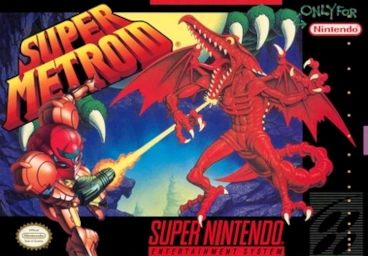
| DATA | |
|---|---|
| Developer(s) | Nintendo R&D1, Intelligent Systems |
| Genre | Action-adventure |
| Platform(s) |  |
| Release date | 1994-03-19 |
My anticipation for this game was as high as the mean score it held in reviews worldwide, usually placed in many of the "top games ever" listings. When I booted it, I encountered an intro with crisp artwork, atmospheric and ominous music, and a nice voice-over to top it up, conforming to a suggestive presentation. So I got myself ready to enjoy an astounding gaming experience.
Ah, how little did that hope last. No audible narration was heard again. The music, except for the few boss themes, soon faded into ordinary "ambient" tunes, the kind you listen to in the background while doing chores, not paying attention. Elevator music, if you want. I barely noticed it was still there and right now I can't even remember most songs.
The graphics, on the other hand, kept the high level and are by far the feature I'd highlight most out of the entire package. While not up to masterpieces like Donkey Kong Country or Yoshi's Island, they're nice to look at and some special effects, such as the X-ray mode, look impressive. Nothing to complain in this aspect.
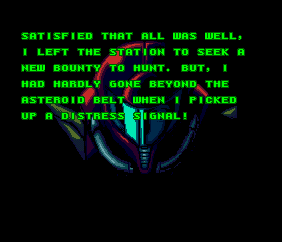
There's no story at all. After the intro, you won't find any kind of exposition, and you'll spend the whole adventure alone. No other characters to speak with, no handwritten diaries, computer logs or anything. You just have to infer everything from what's happening around, but I guess that's okay as it could all be summarized in half a sheet of letter paper. At the end there's something akin to a plot twist, but I'd rather put it as an attempt to give the player an emotional moment. It's certainly memorable (more than the journey that precedes it, that is), but not enough.
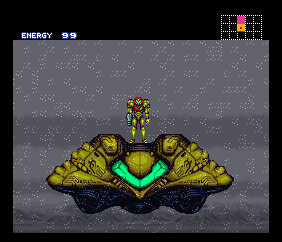
The gameplay is classified as "Metroidvania". If you graduated from high school, you probably noticed that the title of this game is contained within that term. This means that the Metroid saga was one of the contributors to the popularization of the genre. It can be explained as a non-linear action platformer, where you wander around more or less open levels, with a certain degree of freedom. Think about a Super Mario where you can go back and forth between maps interconnected with one or more paths, and where obstacles have been carefully placed as to force you to obtain a given power-up or item before getting past them. You arrive at a new region and explore it until reaching a door that requires a missile to unlock it. You retrace your steps and visit another area where said missiles can be found, and perhaps they're stashed behind a barrier that must be blown up with a high explosive charge, that you must fetch from a third map, and so on.
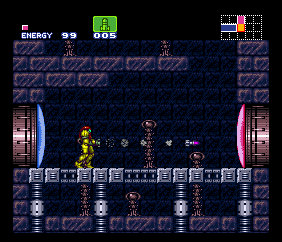
This can be a rewarding experience when properly set up, that is, if designed to be balanced and compensate your efforts properly, giving a logical sense of progression. Super Metroid didn't feel like that. After an initial hour in which I was actually having fun, I soon ran into several dead ends that puzzled me. I revisited all known rooms once and again, trying every tactic, but the solution eluded me. To my real shame, I had to resort to a walkthrough, something which I had promised myself not to, only to realize that the way past the stalemate was hidden in such a wicked manner as to be reprehensible. Many areas are hidden behind special surfaces that are usually hard to find, or directly hidden. It's a matter of luck, not talent.
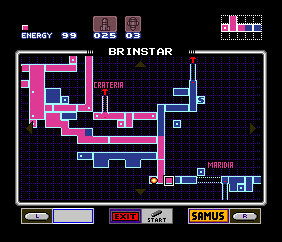
And it happened again, and again. For example, in one occasion a tunnel was hidden under perfectly normal-looking floor blocks, requiring you to somehow shoot them by chance while fighting enemies. Apparently, the creators of this game intended for you to shoot and/or bomb (with both your standard attack and the special ones, as barriers are weak against a single type) EVERY goddamn map tile in order to find all hidden paths, many of which are necessary to progress (not talking only about bonus areas here). And I don't even want to mention a certain glass tunnel, that I still have nightmares with. What were they thinking?
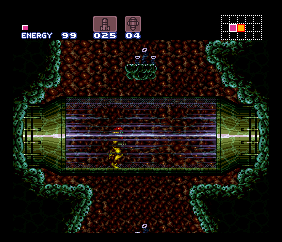
This, coupled to the fact that backtracking is part of the core gameplay, annoyed me big time. There's a helpful map, but you can only check the current region you're at, so please follow my advice and play with a notepad so you can write down every "pending" task. Otherwise you'll lose track of it half an hour later when several more have accumulated, trust me. That way, when unlocking new gear you'll spare yourself from traversing all worlds again, trying to find the place where you're supposed to use it.
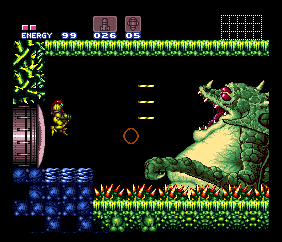
The controls seemed correct at first glance, and they can be configured. But after a while I realized how clumsy the character feels when trying to negotiate platforms. The physics are odd and I can hardly recall experiences as miserable as trying to get past an area with small one-block platforms plus a spiky ceiling, or maybe a lava floor, or enemies (or what the hell, all of them at the same time). When hurt, Samus is pushed back, adding insult to the injury and increasing the chances of my first piercing the wall. Platforming in the last levels made me feel angry like nothing else before in my life.
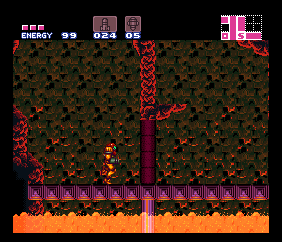
Wait, that reminds me of something worse. Later in the game you need to use new movement techniques and they're so cumbersome that I find hard to believe this game was ever playtested. The grappling hook made me want to hang Samus with it to spare her the agony; the gamepad button I had assigned to load the emulator state was pressed so many times it became stuck. The space jump requires meticulous timing and I failed 9 out of 10 times. I kept looking YouTube videos to try to understand what I was doing wrong, to no avail. "Ha ha yes, the controls in this game are so finicky" what the most common answer online. Accept it or quit.
But the golden award goes to the shinespark (a.k.a. the super jump, or charged jump) and the wall jump, two moves that... are not even documented in the game manual! The first one is also dependent on your health level (vile idea), and the second is as awkward and unintuitive as a human-designed concept can be. You may argue that they're not strictly necessary to complete the game, but it's not hard for the player to become stuck in an optional area (absolutely impossible to differentiate from the main ones in your first attempt) with no clue about how to get out.
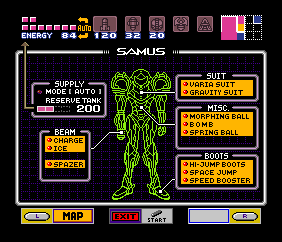
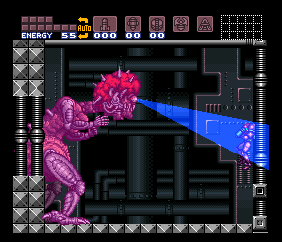
Nothing to say about the few bosses. They're what you expect: a large health bar and hard to avoid attacks. They usually require specific strategies to finish them off.
The final score was going to be a 7, but I went with a 6.5 because during the ending segment I kept wishing for the developers to be bombarded with ionizing radiation. I repeat: it's not a bad game, taken as a whole. Not that disaster called Super Star Wars. And several things were groundbreaking for the kids of 1994 (who could only afford one or two games per year in most cases). But it's way overrated.
I felt guilty for not liking it that much. I wanted to be fair, and to really understand why people held it in such high regard. Perhaps I was wrong? So I began reading reviews while listening to the soundtrack. And I found that, on the Internet, people admit:
- That they began enjoying the game after learning it by memory, following several runs.
- That you have to actually shoot and bomb every tile to find hidden paths. It's part of the "charm."
- That yes, they had to consult a guide once or twice after getting stuck.
- That the controls are indeed "peculiar."
So well, there you have it. I'm confident that nostalgia factor is a big contributor to the inflated ratings, in addition to the more successful sequels. Or maybe I'm just unskilled, which could also be a valid possibility (but it's not).
Playing
As usual, it never left the Nintendo ecosystem, so the only option nowadays is the Super NES – Nintendo Classics for the Switch and Switch 2 consoles. Otherwise, well, an emulator.