


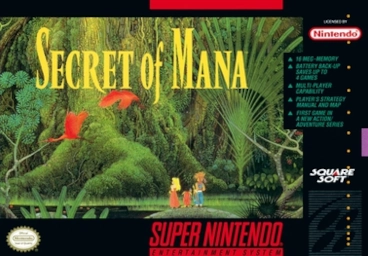
| DATA | |
|---|---|
| Other names | Seiken Densetsu 2 |
| Developer(s) | SquareSoft |
| Genre | Action RPG |
| Platform(s) |  |
| Release date | 1993-08-06 |
When it comes to video games, one of the things I'm proudest of is to always adopt a contemporary perspective in order to analyze them objectively. Even as a teen, I transported myself back in time to the same year the software was released in, adopting the context, in order to fully appreciate its merits. I could play a 1990 classic in 2010 and think "Wow, these graphics are incredible." I pity those who reject playing games released more than five years earlier, stating that "they're too old", not seeing past the technical aspect. How can you neglect your self discipline in such a way?
However, this only applies to the graphics. I can't forgive cumbersome gameplay or wacky controls. There's no excuse: Pong, a 1972 game, was already good in both aspects.
When looking at current retrospective reviews of Secret of Mana (rated a masterpiece by many publications), I see that they tend to be divisive, but its advocates are bellicose. I wouldn't dare posting this review in Reddit, for example. Luckily, since I have my very own webpage (and it lacks a comments section), nobody can come here to berate me. So let's begin dissecting the mistakes.
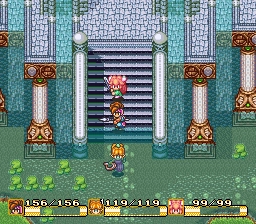
Upon booting the cartridge, you are greeted by pretty and colorful graphics, and dreamy melodies that make you foretell a good experience. But then you begin a new game and, hour after hour, this initial impression is slowly pulled down until you eventually ponder if finishing it will be worth the grinding (and the answer is: no).
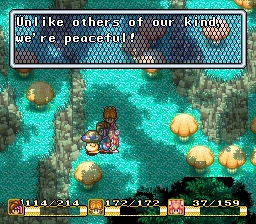
The story is bare-bones. Near the end there's a kind of plot twist, but the rest is as simple as it gets. You control 3 well-meaning kids (one of them, the "chosen one" with an Excalibur-like sword) who must confront an evil sorcerer intending to conquer or perhaps destroy the world. Characters are mostly one-dimensional. And this is a JPRG. That "J" at the beginning means that the story can be kind of childish, yet dramatic at the same time, and with an odd sense of humor (Maybe it gets lost in translation? That would explain some dialogs). No matter how many of these I play, I can never get the hang of this strange mix. Guess I should've been born in Japan to understand it. Well, at least we got cute sprites.
The game introduced a new menu system that did away with the series of text-filled screens. Now, items and options appear superimposed to the play area, in a ring circling the chosen character, and you can rotate left or right to make a selection, or move up and down to switch to another category. At first this can look impressive. Then you actually try to use it, and realize how tiresome it is. Navigation is slow, and when your characters are bunched together it's quite hard to know whose inventory you're looking at. There are no item descriptions and buying new gear is confusing and time consuming (you only get an icon showing who can equip it, to know whether or not it's an improvement you need to leave the conversation and equip it). Yeah, I soon began to miss the old screens.
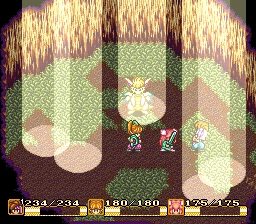
This could be tolerable were it not for the combat. That's the weakest link of SOM by a wide margin. It takes place in pseudo real time, meaning that it gives the illusion of being a 2D hack and slash, but the actual outcome is decided statistically in the background. This makes you feel clumsy as there's no visual feedback on stuff like evasion (which many enemies have a high level of), wondering why your attacks aren't registering. Your characters have a power meter and any stroke performed at less than 100% is basically worthless, plus special combos require you to charge one or more additional bars, slowing combat to a crawl. On top of this, foes can (and will) poison, freeze, petrify or shrink you, put you to sleep, invert your controls, turn you into a furry or whatever. There are a lot of nasty "statuses" that can be induced upon you, all of them annoying, and it would seem that's their main tactic. They can even lead to the death of a character if planets don't align.
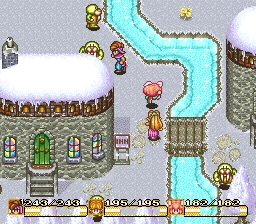
Difficulty is very irregular. Some parts (not many) are a breeze. Some (the most) can get you brutally sodomized, forcing you to devote time leveling the kids up. On average, it leans towards the hard side. You'll meet common enemies that will sweep the floor with you, chaining combos and dodging attacks, better than any boss could (and the latter can be brutal too).
There's a lot of grinding. There are a total of 8 different weapons and each can be upgraded 8 times, plus the handling ability of each of the 3 characters must also be increased for every weapon independently. Not only that: two of the characters can cast magic of 8 different elemental types (water, fire, darkness, light, etc) and the spells must also be trained in order to survive. These overlapping progression systems make SOM feel like a chore.
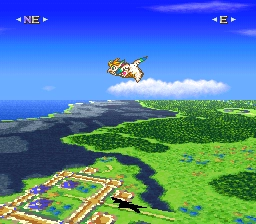
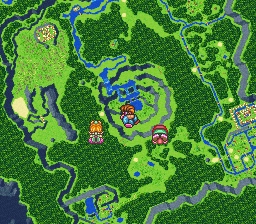
Traveling through the game world to fulfill the objectives requires a lot of backtracking, until you unlock a dragon ride later on (okay, there's also a quick travel business involving a cannon). The map included in the manual is anything but useful. Some actions, like entering the final fortress, are not straightforward and I had to consult a walkthrough, but for the most part SOM is very linear, as seen in its dungeons, with few alternate routes that lead to dead ends. It's more annoying than puzzling.
And talking about moving around, the AI (if we can call it that) exhibits an exasperating pathfinding. Your partners will constantly become stuck at any tree or castle corner, locking the screen until you retrace your steps to "rescue" them. I spent the whole game wishing I could mow them down with my blade, those idiots!
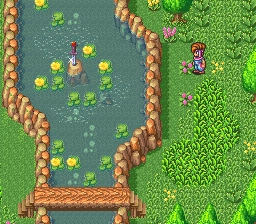
Staring at the end credits, it was clear to me that the game hadn't met my expectations and I kind of regretted the many hours I had invested in it. While technically outstanding for its era, the gameplay is terrible and the story dispensable. I'm confident that nostalgia is the main reason why it's so highly regarded. Let's hope that this review saves you time and effort.
As a side note, there's a curious multiplayer capability that allows up to 3 players (with a Super Multitap to plug the third controller) to enjoy the story cooperatively, joining and leaving at any time. I'm sure that the experience can improve a lot this way, but I haven't been able to verify this.
Playing
- For the SNES original, you'll need to buy it second-hand, or use
an emulator. - An "enhanced" version was published for several mobile platforms (like the Switch) years later. Go to your trusted Nintendo online shop.
- In 2018, a 3D remake was published for Windows and PlayStation 4. It had mixed reviews (take that as you want).